The Names That Stick, and the Name God Gives Instead
Editor's Note: The views and opinions expressed in this article are those of the author and do not necessarily reflect the official policy or position of Regent University, its faculty, administration, or affiliates.
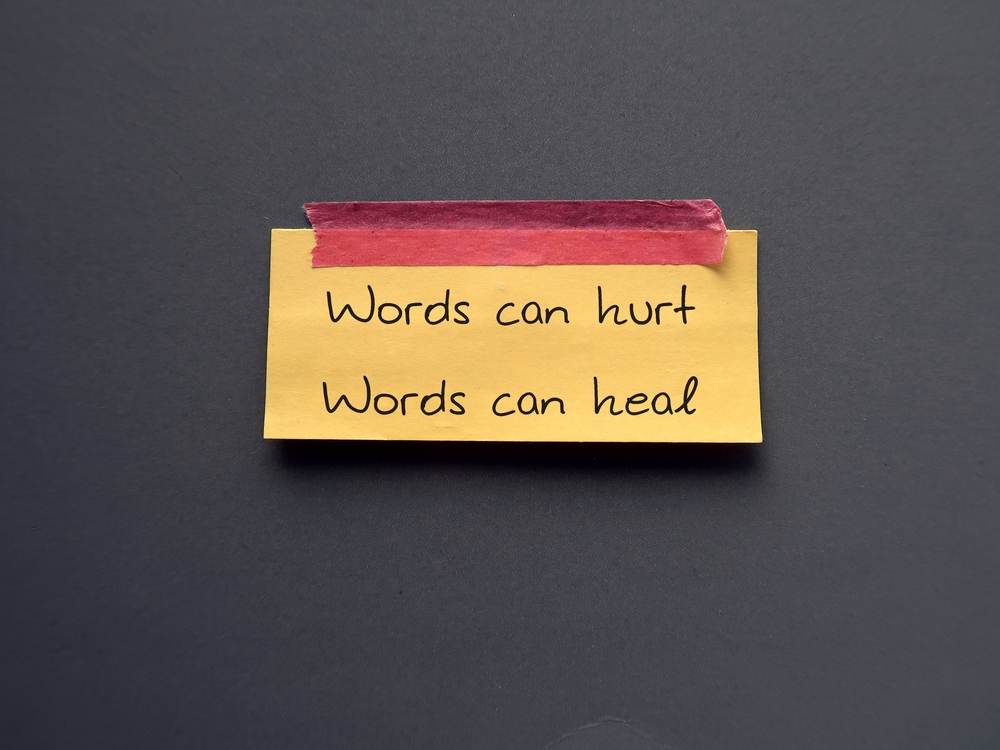
Remember when Mom and Dad taught us this rebuttal to harsh teasing? “Sticks and stones may break my bones, but words will never hurt me.” The truth is, sticks and stones do hurt. Sometimes nicknames hurt even more. And in an age when a single audio or video clip can circle the globe before the person who said it has finished their coffee, words don’t just hurt; they harden into permanent labels. But Christ plans on giving us a new name, known only to Him!
As an example of how quickly critical words can frame a false truth, this summer offered a small case study in how fast that happens. An actor known for playing a tough-guy hero used a podcast appearance to unload months of frustration on a sitting president, and within hours a White House spokesperson fired back with an insult of his own (Boykin-Patterson, 2026). One of the labels voiced by the actor was derived from an anonymous and baseless accusation that has been used against this president since his first campaign for the White House (Durden, 2026).
So why do these accusations persist? That is the strange power of a label: it outlives the argument that produced it, outlives the context, and eventually outlives the truth of the matter altogether. Whoever turns out to be right about the underlying dispute, both men have just handed the internet a phrase to attach to their names forever. We have watched this phenomenon before, and it ended far more tragically.
A Name That Outlived the Man
Fifteen years ago this summer, in late July of 2011, it was reported that former major league pitcher Hideki Irabu had been found dead in his California home, having taken his own life (Associated Press, 2011). Irabu had arrived in the United States in the late 1990s billed as the “Japanese Nolan Ryan,” a can’t-miss phenom (Associated Press, 2011). He never lived up to the hype in New York, and after one too many disappointing outings and a lackluster effort to cover first base on a ground ball, Yankees owner George Steinbrenner branded him in front of reporters with a vulgar, humiliating nickname.
That single insult outlasted Irabu’s entire career. Read the obituaries that followed his death, and you will find the same pattern in every one of them. The New York Times led with it (Martin, 2011). A wire report out of The World repeated it a full five years later, in a story marking the anniversary of his death (Agence France-Presse, 2016). Bleacher Report asked its readers to imagine that label “etched on your tombstone for eternity” (Holmes, 2011). One writer, reflecting on Irabu’s death, called it ironic and tragic that a man paid to play a boy’s game would be remembered not for his talent but for a cruel nickname (Sherrier, 2011). Even a 2017 Sports Illustrated retrospective six years after his death, and long after Irabu had reportedly gifted his old owner a mechanical toad as a gesture of forgiveness, still had to explain the label before it could tell any other part of the man’s story (Reiter, 2017).
Nobody set out to write Irabu’s whole life down to four ugly words. But once a label is spoken aloud in public, it develops a life of its own. It gets quoted, then requoted, then treated as the one fact about a person that every other writer is obligated to include. Sticks and stones may break your bones. A label, spoken once by the right person at the wrong moment, can follow you into your own obituary.
The Hero Who Became a Suspect
This year marks another, closely related anniversary — one that shows the same pattern can attach itself to someone who did absolutely nothing wrong.
On July 27, 1996, security guard Richard Jewell spotted an unattended backpack in Atlanta’s Centennial Olympic Park, alerted police, and helped clear the area before the pipe bomb inside it exploded, killing one person and injuring more than a hundred others (History.com, 2025). For three days, Jewell was a national hero. Then an unattributed newspaper report named him as the FBI’s lead suspect, and the label replaced the man overnight (Fox News, 2007). Reporters camped outside his mother’s apartment. His life, his habits, and his childhood were dissected on live television. He was never arrested. He was never charged. Three months later, the Justice Department formally cleared him, and Attorney General Janet Reno told the press, “I think we owe him an apology” (Fox News, 2007).
The real bomber, Eric Rudolph, would not be caught for another seven years (History.com, 2025). By then, the word “suspect” had already done its damage. Jewell spent the rest of his life working in law enforcement, giving talks to journalism students, and pursuing libel suits against the outlets that never bothered to wait for the facts (History.com, 2025). He died of heart failure in 2007 at age 44. His widow later said plainly that the ordeal killed him; that the label, once attached, was never fully removed, even after the government itself admitted it was wrong (WSB-TV, 2026). Nearly every obituary written that week still led with the word “suspect” before it mentioned the word “hero.”
Two men. One insulted for falling short of impossible expectations; one falsely accused of an act of terrorism he not only didn’t commit but actively prevented. Different mistakes or, in Jewell’s case, no mistake at all but the same tragic outcome. A label, once it sticks, does not care whether it was earned, exaggerated, or entirely false. It simply attaches itself to a name and refuses to let go.
What This Means for Us, Right Now
We are living through a season in which labeling other people has become something close to a national pastime. Turn on any cable news channel, scroll through any comment section, and you will find Americans of every political persuasion reaching for the same handful of words: traitor, hater, extremist, sellout, and hurling them at anyone who disagrees. It happens on the left and on the right, in Hollywood and in Washington and in our own group texts. Perhaps all of us, at some point, reduced a complicated person to a single ugly word because it was faster than doing the harder work of understanding them.
Scripture does not treat this as a minor character flaw. James warns that the tongue is “a fire, a world of unrighteousness” that “sets on fire the entire course of life” (James 3:6, ESV). The Apostle Paul is more specific still: “Let no corrupting talk come out of your mouths, but only such as is good for building up, as fits the occasion, that it may give grace to those who hear” (Ephesians 4:29). Notice what that verse does not say. It does not say never criticize, never disagree, never hold anyone accountable. It says our words should build up even our hardest words, even our most necessary disagreements, rather than exist simply to wound and to stick.
The God Who Renames Us
Here is where the gospel breaks the pattern that swallowed Irabu and Jewell whole. Scripture is full of people whose worst moment or deepest flaw threatened to become their permanent label and whom God renamed instead. Abram, a childless wanderer, became Abraham, “father of a multitude” (Genesis 17:5). Jacob, whose very name meant “deceiver,” wrestled with God and rose as Israel (Genesis 32:28). Simon, an impulsive fisherman who would deny Christ three times in a single night, was told he would be Peter, “the rock,” before he had done anything to deserve it (John 1:42). Saul, a man who dragged Christians to prison and approved of their execution, became Paul, the church’s greatest missionary (Acts 13:9).
In every case, God looked past the label the world was ready to assign coward, deceiver, denier, persecutor and spoke a different name over the same person. That pattern culminates in the promise given to the church at Pergamum: “To the one who is victorious, I will give some of the hidden manna. I will also give that person a white stone with a new name written on it, known only to the one who receives it” (Revelation 2:17, NIV). The name the world hangs on us will not be the name that God intends to bestow upon us.
That does not mean the world’s labels stop hurting, or that we are free to ignore the real consequences of our own actions and failures. Irabu’s struggles were real; Jewell’s exoneration did not undo three months of public torment. But it does mean that no label deserved or not, true or false, spoken in anger or in ignorance, gets to be the final word on a person made in the image of God. We are, as the psalmist wrote, “fearfully and wonderfully made” (Psalm 139:14) by a Father who knows our true name and is not confused by the ones the world insists on using.
The next time a label is aimed at you or the next time you are tempted to aim one at someone else, it is worth remembering the obituaries of Hideki Irabu and Richard Jewell. Words do not disappear once they are spoken. They stick, sometimes for a lifetime, sometimes past it. The only lasting defense against a world eager to define us by our worst moment is a Savior who has already promised us a better name.
Sources:
Agence France-Presse. (2016, August 1). Suicide suspected in death of Japanese ex-New York Yankees pitcher Hideki Irabu. TheWorld.org [Web News Blog]. https://theworld.org/stories/2016/08/01/suicide-suspected-death-japanese-ex-new-york-yankees-pitcher-hideki-irabu.
Associated Press. (2011, July 28). Hideki Irabu found dead in California. ESPN MLB News. https://www.espn.com/mlb/story/_/id/6813233/former-new-york-yankees-pitcher-hideki-irabu-found-dead-california.
Boykin-Patterson, B. (2026, July 27). ‘Reacher’ star sounds off after podcaster tells him to ‘let go’ of Trump hate. The Daily Beast [Web News Blog]. https://www.thedailybeast.com/obsessed/reacher-star-alan-ritchson-sounds-off-after-podcaster-tells-him-to-let-go-of-trump-hate/.
Durden, T. (2026, July 30). Jack Reacher Star’s Latest Movie Flops After Unhinged Anti-Trump Rant. Zero Hedge [Web News Blog]. Retrieved from https://patriot.tv/jack-reacher-stars-latest-movie-flops-after-unhinged-anti-trump-rant/.
Fox News. (2007, August 29). Richard Jewell, wrongly accused in Atlanta Olympics bombing, dead at 44. https://foxnews.com/story/richard-jewell-wrongly-accused-in-atlanta-olympics-bombing-dead-at-44.amp.
History.com Editors. (2025, May 28). Richard Jewell, hero security guard wrongly accused as Olympic bombing suspect, dies. HISTORY. https://www.history.com/this-day-in-history/august-29/hero-security-guard-wrongly-accused-as-bombing-suspect-dies.
Holmes, T. (2011, July 28). Hideki Irabu’s tragic death ushers need for change. Bleacher Report [Web News Blog]. https://bleacherreport.com/articles/782585-hideki-irabus-death-tragic-end-ushers-need-for-change.
Martin, D. (2011, July 28). Hideki Irabu, briefly a Yankee sensation, dies at 42. The New York Times. https://www.nytimes.com/2011/07/29/sports/baseball/ex-yankee-hideki-irabu-is-dead-at-42.html.
Reiter, B. (2017, August 1). The complicated life and death of Hideki Irabu. Sports Illustrated. https://www.si.com/mlb/2017/08/01/hideki-irabu.
Sherrier, J. (2011, July 30). Hideki Irabu: ‘Fat…toad.’ Patch.com [Community Web Blog]. https://patch.com/virginia/chantilly/bp–hideki-irabu-fattoad.
WSB-TV. (2026, July). Richard Jewell’s wife remembers late husband, getting his name cleared in Atlanta Olympic bombing. https://www.wsbtv.com/news/local/atlanta/wife-remembers-late-husband-richard-jewell-originally-believed-part-atlanta-olympic-bombing/REGC3ZRZRVGFBOIVIPCIL6IIIE/.