True Self-Governance by Love Alone: What a Classroom Experiment Reveals About Democracy and Discipleship
Editor's Note: The views and opinions expressed in this article are those of the author and do not necessarily reflect the official policy or position of Regent University, its faculty, administration, or affiliates.
Could a simple classroom experiment demonstrate how utterly unprepared the next generation is for self-governance? Yes, it can… and we have the receipts to prove that it is accurate!
Picture a college seminar on its first day (Finkel, 2000). The professor declares to the class: “I am not going to tell you what to do. This class is yours.” Then he sits down, opens his book, and says almost nothing for the rest of the term.
What happens next, according to educational researcher Donald Finkel, is not liberation. It is agony. The silence stretches for minutes that feel like hours. Students stare at the professor rather than at each other, waiting for him to rescue them from the discomfort of having to think for themselves. Only after weeks of visible struggle does the group learn to stop looking at him and start looking at one another for support and direction (Finkel, 2000).
Finkel’s point is not really about the teaching method. It is about something underneath the surface of every classroom, every institution, and, it might be said, every attempt at self-governance: we do not naturally want to govern ourselves. We long to be led, to be cared-for. We default to an authority to direct us (Finkel, 2000). This is true not only in the classroom, but in our republic as well. Mature self-governance requires a stable framework of authority (our Constitution) that respects the dignity of its members and allows them to develop their own voice. In all of world history, there is really only one approach where this can work.
The Yearning Underneath the Silence
Finkel draws on Freud’s concept of transference to explain his point regarding classroom self-governance (Finkel, 2000). This classroom interaction is a metaphor for our own efforts at independence. As infants, we depend completely on a parent who meets every need before we can even name it — food, warmth, comfort, security, all supplied by an all-powerful, all-loving figure. We never fully forget that experience. As adults, Finkel argues, we carry a permanent, largely unconscious yearning to be cared for again by someone with that kind of power (Finkel, 2000). In moments of difficulty, we transfer that yearning onto whoever holds authority over us — a teacher, an employer, a government.
Maturity, in Finkel’s account, is not the disappearance of this yearning. It is becoming conscious of it, so that we stop letting it drive our decisions. His students didn’t fail because they wanted the teacher’s approval. They struggled because they didn’t know that wanting his approval was the very thing keeping them from thinking for themselves.
This is where Finkel makes a distinction worth noting: Power is the ability to make things happen — grades, assignments, directions given and obeyed. Authority is different: Authority is what legitimizes an arrangement in the first place. Authority is consciously inherent without needing to be exercised, and it is often grounded in something beyond the present moment. The professor never gave up his authority. He remained the founder of the class, the one who set its terms and still assigned its grades. What he gave up was power over the daily texture of the room — what got discussed and how. That separation, Finkel argues, is what a genuinely democratic classroom experience requires: authority intact, power distributed. This becomes a reflection on our own efforts at self-governance. And the data suggests that the next generation has not learned this lesson.
A Nation of Dependent Students
If Finkel is right about this dynamic in the classroom, it is worth asking what he might say about a nation of eighteen-to-twenty-nine-year-olds who report feeling disengaged from politics. A major 2025 study by CIRCLE (the Center for Information and Research on Civic Learning and Engagement) surveyed young Americans after the 2024 election and found data to support Finkel’s premises: 63 percent of young people surveyed value the basic principles of democracy, but remain relatively disengaged from civic action (CIRCLE, 2025). The researchers labeled this group as “Passive Appreciation.” Nearly a third of those surveyed were labeled “Dismissive Detachment” — having checked out of a system that hasn’t served them well. And 7 percent of those surveyed were labeled “Hostile Dissatisfaction.” This group still believes in the country’s founding principles but is dissatisfied enough with democracy as practiced that they are willing to consider political violence to achieve change (Apau et al., 2025).
That last figure should scare us; and it is perhaps the reason we see an increase in political violence today. The same research found that fear of political violence and the sting of polarization don’t automatically produce support for authoritarian tactics — but they can push young people toward more extreme methods of reform, even among those with real advantages like education and a sense of political efficacy (Apau et al., 2025). Separately, other research on Gen Z civic engagement found a high degree of cynicism toward institutions generally, but notably higher trust placed in teachers than in almost any other authority figure (Murmuration Research, 2025). This could suggest how campus politics is still influencing young people greatly in their approach (Binder and Kidder, 2022). This sums up what Finkel described in his classroom: young people looking for someone worth trusting while distrusting themselves.
Read deeper into Finkel’s contention: this generation is not honest enough to name what they are really longing for — but it is not because they haven’t tried. Unable to acknowledge their desire to be led, the yearning does not vanish. It finds someone with which to attach itself: usually whichever voice is loudest, most certain, and most willing to promise total care to an anxious heart that is already primed to want. Here is where Finkel’s conclusions from the classroom extend onto something larger than pedagogy or politics. His account of the classroom interaction, when read carefully, describes the oldest story we have.
The Garden and the Reversal
The temptation in the Garden of Eden was never really about a piece of fruit. It was an offer to seize power that was never ours to hold — to decide good and evil for ourselves rather than trust the Benevolent Authority of the One who had already declared it good. Every account of human history since has been some version of that same reach: a creature who longs, at the deepest level, to be cared for perfectly by a Father-figure; yet choosing instead to grasp at self-rule. We have called this political experiment many different things. But Genesis named it first, and named it correctly, as rebellion rather than maturity.
This is why I have come to think that democracy is not, as it’s often described, a political expression of Christian conviction. In its bare form, it may be closer to the opposite of it. Democracy assumes a people capable of ruling themselves well. Scripture assumes a people who cannot, but who are loved enough by their Maker to be told so – and yet provided with a path to a glorious experience in Absolute Love.
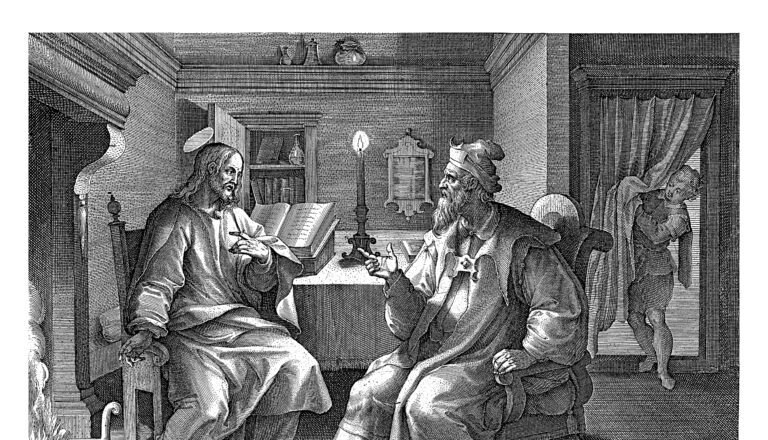
There is then a second half to this idea that Finkel’s classroom experiment, without knowing it, points straight toward — and it is the most hopeful part. Christ holds all authority in heaven and on earth (Matthew 28:18 ESV). He could have used that authority, as could have the professor in the classroom: to control what we think, to compel our affection, to remove the discomfort of choice altogether. Christ did not do this. He used his power instead to shield us from the self-centeredness the garden unleashed, and then set us free — genuinely free — to love one another as he has loved us (John 13:34). “For freedom Christ has set us free,” Paul writes; but here this represents that freedom was never license, but love, to serve one another rather than gratifying the flesh (Galatians 5:1, 13).
That is democracy in its purest form: not a people capable of governing themselves by their own maturity; but a people freed by a Father who retains all authority, and yet declines to use His power to control them — choosing instead to let them struggle, choose, and love, inside a relationship secure enough to bear the weight of that freedom.
Governed by Love, Not Left to Ourselves
The professor’s students eventually learned to turn from him toward one another — but only because his authority never actually left the room (Finkel, 2000). It gave the whole risky experiment the safety to lean into self-governance. Remove that founding authority, and self-governance collapses into either chaos or a scramble for whoever will fill the vacuum with certainty.
The maturity to govern ourselves, then, was never meant to be self-generated. It was meant to be received — from founders who clearly understood the responsibility of this experiment (Smith, et al, 2005). Our Founding Fathers understood that this gift of self-governance was bestowed on frail human being by a Heavenly Father who holds all power and all authority, who has already met the deepest yearning any of us carry, and who sends us back into the world not to rule ourselves alone, but to govern ourselves in love, because we have first been so thoroughly, patiently governed by Him in love (Psalm 103:13). God help us, that we do not fail to demonstrate to the next generation how to maturely govern and prosper well in Our Father’s love!
Sources
- Apau, D., Suzuki, S., Medina, A., & Booth, R. B. (2025). How does Gen Z really feel about democracy? Insights from three profiles of youth and democracy. CIRCLE (Center for Information & Research on Civic Learning and Engagement) & Protect Democracy. Retrieved from https://circle.tufts.edu/sites/default/files/2025-04/genz_democracy_report_2025.pdf.
- Binder, A.J.; & Kidder, J.L. (2022). The Channels of Student Activism: How the Left and Right Are Winning (and Losing) in Campus Politics Today. Chicago: University of Chicago Press.
- CIRCLE, (2025, April 7). Report: How Does Gen Z Really Feel about Democracy? Tufts University: Center for Information and Research on Civic Learning and Engagement. Retrieved from https://circle.tufts.edu/report-genz-attitudes-democracy.
- Finkel, D. (2000). Teaching With Your Mouth Shut. Portsmouth, NH: Heinemann.
- Murmuration Research (2025). Understanding Gen Z: Barriers to civic engagement. Murmuration [Research Reports]. Retrieved from https://murmuration.org/research/barriers-to-gen-z-civic-engagement.
- Smith, L.M., Smith, K.T., & Mulig, E.V. (2005). Application and assessment of an ethics presentation for accounting and business classes. Journal of Business Ethics, 61(2), 153–164.