The Constitution’s Link to the Declaration of Independence
Editor's Note: The views and opinions expressed in this article are those of the author and do not necessarily reflect the official policy or position of Regent University, its faculty, administration, or affiliates.
Written by Dr. Nicholas Higgins, Ph.D.
Dr. Nicholas Higgins is a Professor at North Greenville University and Jack Miller Teaching Fellow. He is committed to the revival of American Civic Education through promoting primary teacher education and college students learning about the American Political Tradition. Nicholas lives in Greenville with his wife and six kids.
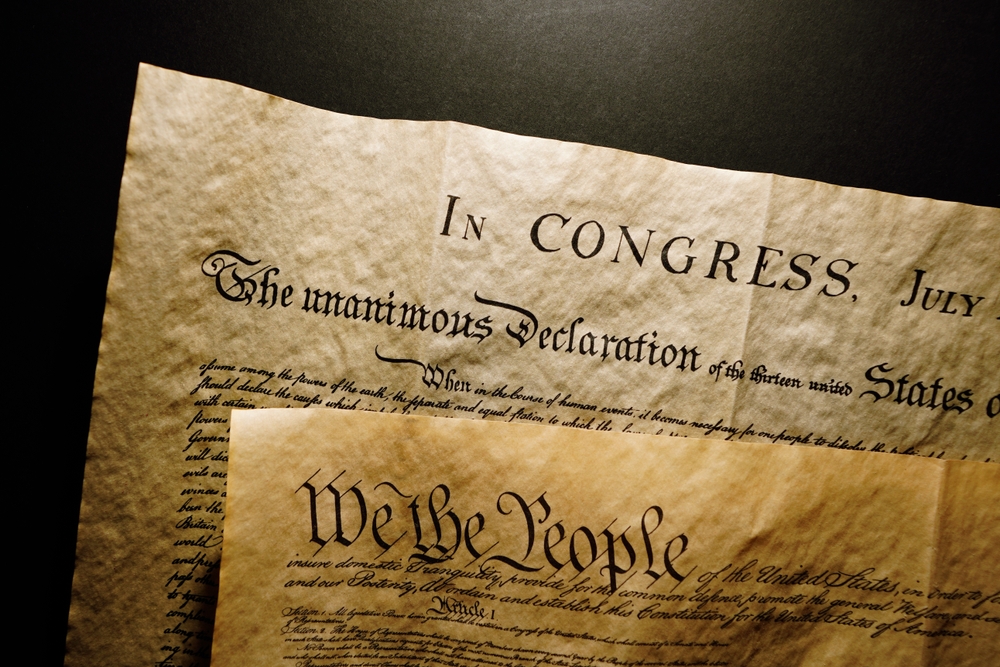
As we celebrate America’s 250th anniversary, emphasizing the centrality and importance of our Declaration of Independence, we would be remiss to forget that our Constitution itself is built upon the ideas and principles of the Declaration. Abraham Lincoln reflected deeply on the relationship between these two documents, turning to a biblical metaphor from Proverbs 25:11: “A word fitly spoken is like apples of gold in pictures of silver.” For Lincoln, the Declaration’s assertion of liberty and equality was that “apple of gold.” “The assertion of that principle, at that time, was the word ‘fitly spoken’ which has proved an ‘apple of gold’ to us. The Union, and the Constitution, are the picture of silver, subsequently framed around it.” Thus, as we turn to celebrate our Constitution, it is necessary to see its relation to the Declaration.
We must acknowledge there are some differences, arising from distinct purposes. The Declaration of Independence is, in essence, the ultimate political “breakup letter.” It is an explanation to a “candid world” of non-stakeholders of the radical actions the colonies were taking against England. It famously grounds this separation first in propositional truths regarding human nature and God-given rights, and second in a specific list of grievances highlighting the failures of King George III. The Constitution, however, is a prudential exercise in statecraft. While it presumes philosophical truths, it does not explicate them. It is a deliberate construction of a functional system of limited power prescribing exactly who can do what to whom, and how.
Despite the difference in goal, their alignment is specifically seen in three critical areas: the institutionalized acts to protect against specific grievances mentioned, recognition of the same source of political authority, and the practical and prudential attempt to realize the principle of liberty and equality for all.
The Constitution is not merely a theoretical exercise; it is a direct, legal resolution to the administrative abuses listed in the Declaration’s grievances. Where the Declaration complained, the Constitution protected.
The Declaration provides a list of 27 grievances against the king. In many ways, these ideas shaped critical components of our Constitution. I will mention only a few for now. Where the Declaration grieved the deprivation “of the benefits of Trial by Jury,” Article III, Section 2 guarantees that “The Trial of all Crimes… shall be by Jury.” We constitutionalize the necessity of the people ensuring the laws are adjudicated fairly. Further, consider the Declaration’s lament, which is the one idea most students can identify: “For imposing Taxes on us without our Consent.” The Constitution resolves this in Article I, Section 7, mandating that all revenue bills originate in the House of Representatives. And again, the Declaration indicted the King because “He has made Judges dependent on his Will alone, for the tenure of their offices, and the amount and payment of their salaries.” The founders remedied this in Article III, Section 1, ensuring federal judges hold office during “good Behaviour” and receive compensation that “shall not be diminished” in order to ensure an independent judiciary can not be forced to follow the will of another.
The Declaration, rooted in the Enlightenment ideas of John Locke and others, asserts that governments derive their “just powers from the consent of the governed,” and, following the Christian ideas of Natural Law, that all laws must conform to eternal principles rooted in the created order. It asserts the ultimate right of the people to alter or abolish their government, while soberly warning that such changes should not be for “light and transient causes.”
The Constitution seeks to institutionalize this very framework. It acknowledges the pursuit of a “more perfect Union,” identifying an ongoing trajectory of improvement permitted through Article V and the amendment process rather than an assertion of immediate perfection. Further, the Constitution’s preamble sought to ensure that, unlike the Articles of Confederation, where political power was delegated from the sovereign states, the final version (penned by Gouverneur Morris) establishes the popular sovereignty of the people, creating a nation built by “We the People of the United States.”
The most profound challenge to this argument is the reality of slavery. Some may wonder: can the Constitution be consistent with the proposition that “all men are created equal” if it preserves and promotes slavery? It is my assertion that, just like the Declaration had to compromise on the issue, so too did the Constitution, and yet its compromise was to never permanently create a constitutional protection of slavery and even an attempt to abolish it.
In Thomas Jefferson’s original draft of the Declaration, he included a scathing grievance against the King for maintaining the transatlantic slave trade, writing:
“…he has waged cruel war against human nature itself, violating its most sacred rights of life & liberty in the persons of a distant people who never offended him, captivating & carrying them into slavery in another hemisphere… determined to keep open a market where MEN should be bought & sold…”
Jefferson passionately accused the King of actively preventing colonial attempts to abolish the slave trade, even calling the King an Infidel hiding behind his Christian faith. Yet, this clause, in order to secure the unanimity required for independence, was removed.
The Constitution was born of this same agonizing necessity. Delegates to the convention, such as Gouverneur Morris of New York, lamented that he was “reduced to the dilemma of doing injustice to the Southern States or to human nature, and he must therefore do it to the former” through these compromises. And yet, despite 3 areas of the Constitution clearly talking about slavery, the founders engaged in a linguistic maneuvering that carefully preserved the principles of the Declaration. Most notably, the Constitution entirely omits the words “slave” or “slavery.” The framers refused to validate the institution by naming it, using only euphemisms and thereby denying slavery constitutional legitimacy as a permanent, moral fixture.
Further, in every clause in which the concept is discussed [the Three-Fifths Clause (Article I, Section 2), the Slave Trade Clause (Article I, Section 9), and the Fugitive Slave Clause (Article IV, Section 2)], the Constitution carefully and clearly refers to enslaved individuals as “Persons.” This meant that far from denying personhood to the slaves, the Constitution categorically, specifically, and legally identified slaves as being people who deserve the promises of the Declaration, rather than as mere property or some other degrading view.
This was no accident. Specifically, during the creation of what has now become known as the “Fugitive Slave Clause”, James Madison specifically identified that the term “legally” was struck out from the phrase “No person legally held to service,” and replaced with “under the laws thereof.” [BR1] Madison recorded this was done “in compliance with the wish of some who thought the term legal equivocal, and favoring the idea that slavery was legal in a moral view.” The founders vehemently refused to concede that slavery was a moral good, let alone legal under the laws of Nature’s God.
Finally, with all these compromises, many of the framers in the Constitutional Convention sought to include what they viewed as the legal path to gradual emancipation. Article I, Section 9 allowed Congress to prohibit the importation of persons after the year 1808. While twenty years was a horrific delay for those enslaved, at the time of ratification, this clause was widely viewed as the death knell for the institution.
James Wilson, speaking at the Pennsylvania Ratifying Convention, argued that this clause laid “the foundation for banishing slavery out of this country.” He noted, “If there was no other lovely feature in the Constitution but this one, it would diffuse a beauty over its whole countenance. Yet the lapse of a few years, and Congress will have power to exterminate slavery from within our borders.”
Decades later, the great jurist Joseph Story echoed this sentiment in his Commentaries on the Constitution, noting it was “to the honour of America” to set the first example of abolishing the trade. Story reminded his readers that while European nations eagerly supported the horrific traffic, “America stood forth alone, uncheered and unaided, in stamping ignominy upon this traffic on the very face of her constitution of government.” True to the Constitution’s design, Congress passed legislation to abolish the trade on the very first day it was constitutionally permissible: January 1, 1808.
Thus, as Abraham Lincoln explicated, it would be erroneous not to see the Constitution as consistent with the Declaration. One might even say that the Declaration without the Constitution is merely a list of philosophic ideas but with no practical application. It is also true that the Constitution presumes and even necessitates the Declaration as its moral compass, providing the architecture of good government built on the moral foundation of the Declaration. Without the Declaration is merely a mechanical rulebook devoid of a moral compass. Let us not divorce these two great documents, nor somehow think the founders were schizophrenic; they did not establish a philosophy of human liberty in 1776 only to abandon it for a cynical power grab in 1787. Rather, they undertook the painstaking, compromising, and constructive work of building a government that could actually survive in a fallen world while keeping its eyes fixed on high principles proclaimed in the Declaration.