What Does the Establishment Clause Mean?
Editor's Note: The views and opinions expressed in this article are those of the author and do not necessarily reflect the official policy or position of Regent University, its faculty, administration, or affiliates.
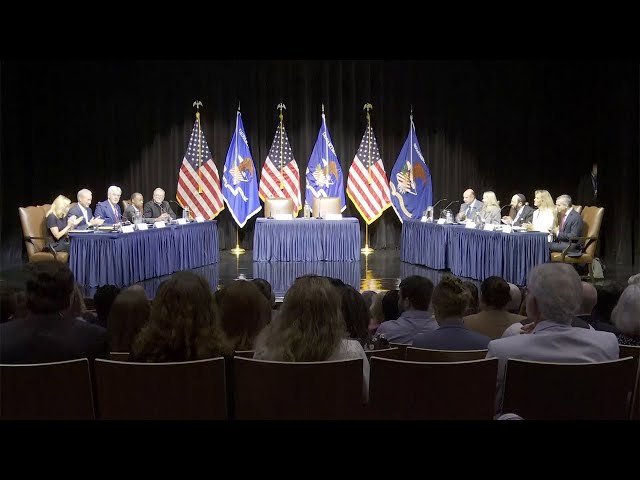
Pastor Paula White and Mark David Hall discuss “What Does the Establishment Clause Mean?” during the first hearing of the Religious Liberty Commission.
Transcript:
Paula White: Can you tell us what the Establishment Clause means, and have the courts gotten off track on that?
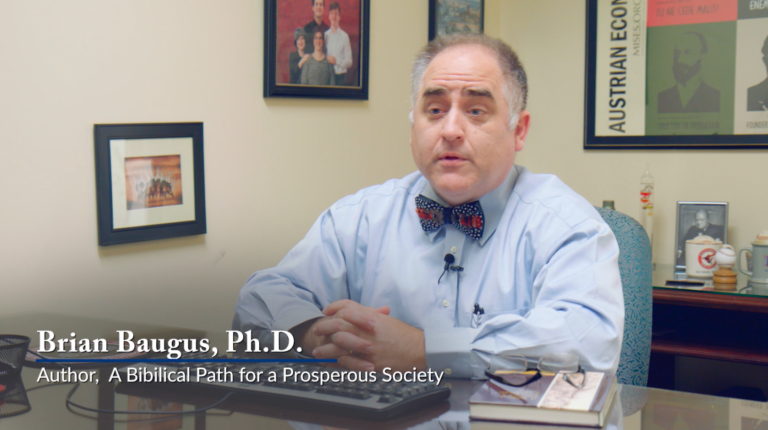
Dr. Mark David Hall: Thank you very much for that question. If you think about the metaphor of “the wall of separation between church and state,” it really does not communicate at all the actual words of the Establishment Clause.
The Establishment Clause begins: “Congress shall make no law respecting an establishment of religion.” That is a unilateral barrier—it’s a restriction on Congress, and through the doctrine of incorporation, and now the states. In no way, shape, or form is it a restriction on churches, synagogues, mosques, or any other sort of religious organization.
But the “wall of separation” metaphor suggests a bilateral barrier, right? That it’s a restriction on government, but it’s also a restriction on religion. In no way, shape, or form is it that.
I’ve already suggested that in 1947, Hugo Black and Wiley Rutledge led us astray by adopting this “wall of separation” metaphor as the defining historical document to inform what the First Amendment means.
One problem with that metaphor is no one ever really believed it, right? If you really take it literally, what—fire departments can’t put out fires in churches? And churches are somehow free of building codes? No one ever argued that.
So, well, if it’s not going to be a wall, what will it be? And the Court basically came up with a flawed analytical test known as the Lemon test that did a lot of damage until it was finally eliminated a few years ago in the Coach Kennedy case.
Related: