Saving Manhood
Editor's Note: The views and opinions expressed in this article are those of the author and do not necessarily reflect the official policy or position of Regent University, its faculty, administration, or affiliates.
Since I’ve already written some articles about family, let me write about how proud I am of my three sons — not the fictional trio from Fred MacMurray’s classic sitcom “My Three Sons” (FETV, n.d.), but my own three sons. Each of them is honoring God with their lives, although the path to this point was not a straight line. It never is.
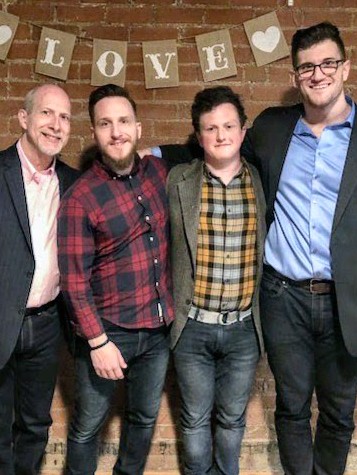
Their mom and I had the honor of watching them grow and interact with their friends. We had the privilege of being there in the highs and lows of competition and loss. We had the pure enjoyment of seeing young men grow to manhood and to achieve goals that they set for themselves. Now we watch in enjoyment as they begin to raise their families. God willing, they will build into their own sons’ lives a passion for life and a strong trust in God. Hopefully they will avoid the mistakes made by their own father, a first-generation Christian man from a broken home who did not have a role model in his own life for how to raise his boys.
What is true today is that all three are married with children and walking in a straight line towards Jesus Christ. What we can all agree on is… This manhood thing is tough!
I grew up in a home that splintered very early, with the marriage not surviving 15 years before separation, then divorce. My father was an angry man who took it out on my mom and his kids. Was this “toxic masculinity” {Flood, 2022) or just an insecure man who hated his job? I held much of his anger towards me inside as well, and later in life would go to counseling so as to not carry forward what my father planted in me, and cause my children to suffer under the same stress.
This led me to always wonder what a true man really looked like. I experimented with relationships until accepting Christ in college. If real manhood is not in pleasing women or oneself through physical means, what then was it? I never felt really comfortable at men’s conferences, mainly because I felt lumped in with gender stereotypes. The speakers would say things like “All men feel this way;” or “We men do this and that.” I would shake my head and disagree with these generalizations.
The pastor of one church we attended suggested that we do a Men’s Bible Study using the classic book, “Wild at Heart” by John Eldredge. While the book has been praised by many men’s authors and pastors, it also has quite a few detractors (Wingerd, 2010). According to Eldredge, there is a divine heart of masculinity, which is how we were designed by God: we were designed to be adventurous and courageous (Eldredge, 2001). Men lose sight of how they were designed because even in the church, we are told that we need to be nice guys and not authentic masculine men. According to the author, this leads to disillusionment and passivity (Eldredge, 2001).
I didn’t know at the time about all of this controversy over the book but trusted the pastor’s suggestion. At the first reading, I was immediately turned off to the book by the way it opened. The author was portraying this rugged individualism that to me was stereotypical of men I observed as I was growing up. The author is on a hunt for the elusive bull elk and uses this “adventure” to make his point that man was born in the outback, from the untamed part of creation. Men since this time have been forced to be domesticated, but man was meant to be wild and free (Eldredge, 2001). I never liked gender generalization, and I still don’t. This was not me that Eldredge was describing. I did not read any further.
In a survey published this calendar year by the UCLA Center for Scholars and Storytellers (Kivowitz, 2026), the findings indicated that today’s youth want to see boys and men portrayed on screen showing more of an emotional connection and vulnerability as compared to other male stereotypes (Kivowitz, 2026). These stereotypes are captured with the term “toxic masculinity.” This refers to a particular version of masculinity that emphasizes the worst aspects of masculine stereotypes, extremes like violence, dominance, sexual entitlement, and hostility toward females (Flood, 2022).
We are so convinced that men are a threat to society that we have cast them as stupid on television shows and shamed them (Hymas, 2025). This is the curse of the Garden: In a perversion of the marital relationship, the Woman seeks dominion over her husband; and the Man abuses his authority to nurture and bless his wife (Garris, 2021). And today we are reaping the whirlwind.
A Florida clinic suggests that “traditional ideas of masculinity aren’t just outdated—they’re dangerous” (Integrated Care Clinic, 2025). I would agree that John Eldredge’s view of men becoming “fully alive” seems to align with this wilderness adventurer dude. I myself, along with several reviewers, was quite happy being “at home indoors” types of guys (Storms, 2011).
But true manhood takes us back before the Curse in the Garden: It is not good for man to act individually without “bone of his bone and flesh of his flesh” (Genesis 2:23 ESV). Manhood is not the classic “Marlboro Man” rugged individualist solo operator. But mature men engage with their female partners, following life’s adventures with ownership of domestic responsibilities, pushing back on the Curse with a helping of grace and wisdom and God‘s guidance.
My boys didn’t grow up in an age when they could choose to escape confronting manhood through mental health counseling. They had to figure it out with an imperfect father, a first-generation Christian, making lots of mistakes along the way.
I am so very proud of my boys, now men. They made mistakes, got into lots of trouble (some of which we will never know about), but ended up on the right side of things. I couldn’t be prouder that today each is married, raising a family, following Christ, and nurturing a loving spouse. And how did they accomplish this? They didn’t have a great role model to start. God brought many kind and understanding mentors into my life, both men and women, who helped me to understand what this manly role should be. Meanwhile, my loving and patient wife and I went to parenting classes, observed other couples, and did our best to learn how to manage our three boys and our two girls.
So where does that leave a generation of imperfect fathers raising imperfect sons in a culture that no longer trusts the word “man”? I keep coming back to the Garden. The curse that fractured Adam and Eve’s marriage, the woman’s desire turned toward control, the man’s strength turned toward tyranny or retreat (Genesis 3:16 ESV; Garris, 2021), is not the final word on manhood. It is the wound. And Christ came to heal it.
Paul tells us that Christ redeemed us from the curse, becoming a curse for us so that the blessing might reach us after all (Galatians 3:13-14 ESV). That redemption is not only about eternity. It reaches into how a husband treats his wife, how a father raises his sons, how a man carries his strength. Jesus did not come to make men soft, and He did not come to make them hard. He came to make them whole.
Look at Jesus. He was fierce enough to braid a whip of cords and overturn the money changers’ tables in His Father’s house, driving out those who had turned worship into a marketplace (John 2:14-17 ESV). That is righteous anger, not rage. It is the very strength that toxic masculinity only counterfeits. Yet this same Jesus, standing at the tomb of His friend Lazarus, wept (John 11:35 ESV). He did not profess strength by hiding His grief. He let it show, in public, unguarded, tears for a friend He loved. Passion and tenderness, held together in one man, at the same moment. That is not a contradiction. That is the design.
Scripture gives us more than one picture of this. Boaz was a man of standing (Ruth 2:1 ESV) who used his strength to protect and provide for a vulnerable widow without ever taking advantage of her. Joseph of Nazareth, the earthly father entrusted with raising Jesus, is called a “just man” who, even while wounded by news that could have shamed him publicly, chose to protect Mary quietly rather than expose her (Matthew 1:19 ESV). David was a warrior who felled a giant; also a worship leader who wrote of weeping on his bed at night (Psalm 6:6 ESV). None of these men fit neatly into either the “wild adventurer” or the “tough guy” mold. They fit into something better: godly manhood.
This is what I hope my sons and now their sons inherit. Not a swagger to perform, and not a passivity to hide behind, but a manhood strong enough to weep and gentle enough to lead. A manhood that pushes back against the Curse instead of hiding inside it, that loves a wife by nurturing her rather than ruling over her, and that shows a watching culture what Christ has already shown us: true strength kneels, true strength weeps, and true strength lays down its life for the ones it loves (John 15:13 ESV; Ephesians 5:25 ESV). That is the manhood worth saving.
Sources:
Eldredge, J. (2001). Wild at Heart. Nashville: Thomas Nelson Publishers
Family Entertainment Television – FETV (n.d.). My Three Sons. https://fetv.tv/shows/my-three-sons/.
Flood, M. (2022, September 21). ‘Toxic masculinity’: what does it mean, where did it come from – and is the term useful or harmful? The Conversation: Trustworthy Science News [Web Blog]. https://theconversation.com/toxic-masculinity-what-does-it-mean-where-did-it-come-from-and-is-the-term-useful-or-harmful-189298.
Garris, Z. (2021, January 5). The Woman’s “Desire” and the Man’s “Rule” (Genesis 3:16). Knowing Scrippture [Web Blog]. https://knowingscripture.com/articles/the-womans-desire-and-the-mans-rule-genesis-3-16.
Hymas, C. (2025, November 15). Men ‘portrayed as either frightening or pathetic in film and TV’. The Telegraph [News Blog]. https://www.telegraph.co.uk/news/2025/11/15/men-portrayed-as-either-frightening-or-pathetic-in-film-tv/.
Integrated Care Clinic (2025, May 8). Mental Health and Masculinity: Breaking the Tough-Guy Mold. Integrated Care Clinic [Counseling Practice Blog]. https://integratedcareclinic.com/blog/mental-health-and-masculinity-breaking-the-tough-guy-mold/.
Kivowitz, E. (2026, February 25). Gen Z and Gen Alpha want to see caring, affectionate dads and vulnerable men in movies and TV. UCLA: Center for Scholars & Storytellers. https://newsroom.ucla.edu/releases/gen-z-gen-alpha-evolving-masculinity-in-movies-tv.
Storms, S (2011, December 8). Review: Wild at Heart. SamStorms.org [Web Blog]. https://www.samstorms.org/all-articles/post/wild-at-heart.
Wingerd, D. (2010, March 30). A Critical Review of John Eldredge’s Wild at Heart. Christian Communicators Worldwide [Web Blog]. https://www.ccwtoday.org/2010/04/a-critical-review-of-john-eldredges-wild-at-heart/.