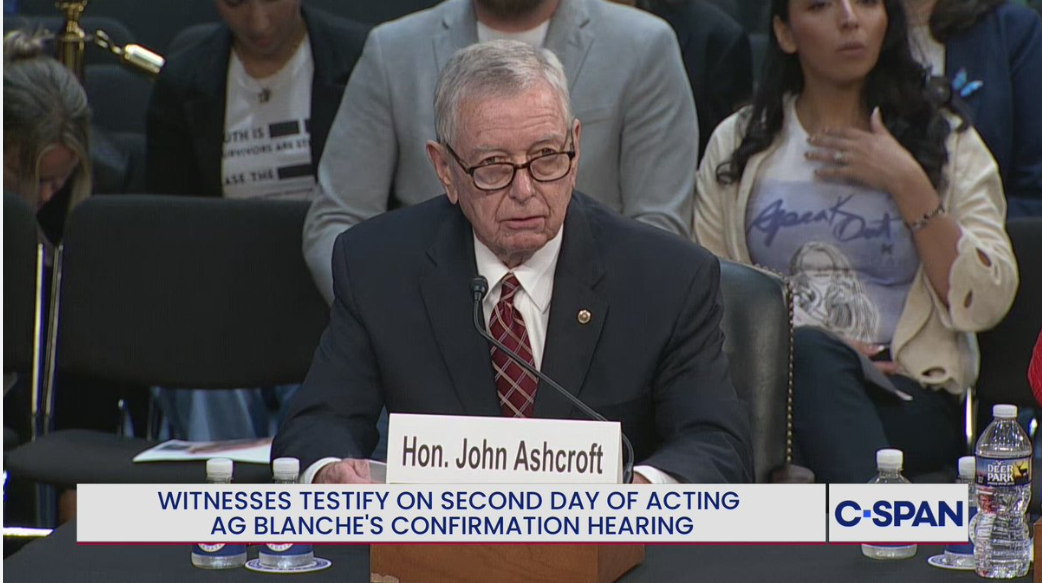
Former Attorney General John Ashcroft Testifies Before Senate, Champions Rule of Law
Editor's Note: The views and opinions expressed in this article are those of the author and do not necessarily reflect the official policy or position of Regent University, its faculty, administration, or affiliates.
Distinguished Professor champions the rule of law while demonstrating Regent University’s impact on the nation’s most consequential conversations
When America’s leaders wrestle with questions of constitutional government, justice, and the rule of law, they often turn to voices with decades of proven legal experience. On July 16, former U.S. Attorney General John Ashcroft, a Distinguished Professor of Law and Government at Regent University, once again found himself where some of the nation’s most consequential debates unfold — before the United States Senate.
Appearing before the Senate Judiciary Committee in support of Acting Attorney General Todd Blanche’s nomination to lead the U.S. Department of Justice, Ashcroft offered more than an endorsement of a nominee. He articulated a vision of impartial justice rooted in constitutional principles, equal application of the law, and faithful public service. His testimony also served as a reminder of the caliber of scholars who teach and mentor students at Regent University.
For nearly five decades, Regent has prepared Christian leaders to influence law, government, education, business, media, and public policy. Ashcroft’s appearance before Congress illustrates how that mission extends far beyond the classroom, bringing thoughtful Christian perspectives to the highest levels of national discourse.
Recommending Blanche, Ashcroft praised his character, leadership, and commitment to the Constitution, describing him as a leader who inspires the Department of Justice’s more than 115,000 employees while safeguarding “America’s core value of liberty” through faithful adherence to the rule of law. Those same themes resurfaced during questioning from members of the committee.
One of the hearing’s most substantive exchanges centered on the proper role of the executive branch in enforcing federal law. During questioning, Sen. Adam Schiff (D-Calif.) expressed concern about presidents directing investigations involving political opponents. Ashcroft responded by emphasizing what he viewed as the governing principle of equal justice.
“I believe that the Attorney General of the United States has the right and responsibility to enforce the law uniformly,” Ashcroft testified. “If the law has been broken by the President’s enemies, he has a duty. They do not become exempt from following the law merely by their enmity to the President.”
Ashcroft repeatedly redirected the discussion away from partisan labels and toward the broader constitutional responsibility of government.
“The determining factor regarding prosecution,” he explained, “is whether a person has violated the law.”
When pressed further about presidential involvement in law enforcement priorities, Ashcroft emphasized that the President bears constitutional responsibility for ensuring federal laws are faithfully executed while warning against selective enforcement driven by political considerations.
“The President … is the executive branch of the United States whose charge it is to enforce the laws of the United States,” Ashcroft said. “His job is to have an administration which calls for the enforcement of the laws of the United States without regard to the political preferences of the people who are perpetrators or accused individuals in the system.”
Whether viewers agreed with every conclusion, the exchange underscored a larger reality: America’s ongoing debate over constitutional governance, prosecutorial independence, and equal justice continues to shape the nation’s civic life. It also highlighted the importance of informed, principled voices capable of engaging those issues with legal expertise rather than political slogans.
For Regent University, Ashcroft’s testimony reflects the institution’s longstanding commitment to equipping leaders who bring Christian conviction, constitutional understanding, and professional excellence into the public square.
That mission lies at the heart of Regent’s Center for Christian Thought & Action, which exists to foster thoughtful engagement with the cultural, legal, and political challenges facing the nation. Rather than retreating from difficult conversations, the Center encourages faithful scholarship that seeks truth, advances human flourishing, and contributes constructively to public life.
Ashcroft’s career embodies that vision.
Before joining Regent’s faculty, he served as Missouri’s state auditor, attorney general, and governor. He represented Missouri in the United States Senate, and later became the nation’s 79th Attorney General. Throughout decades of public service, he has remained a consistent voice on constitutional government, religious liberty, and the rule of law.
Today, Regent students benefit directly from that extraordinary experience. They learn not only from textbooks, but from faculty members who have shaped history, defended constitutional principles, and continue to participate in the conversations defining America’s future.
As the nation confronts increasingly complex legal, political, and cultural questions, universities have an opportunity—and a responsibility—to prepare leaders who can engage those challenges with wisdom, courage, and integrity.
Ashcroft’s appearance before the Senate Judiciary Committee demonstrated that Regent University’s influence is not confined to the academic world or Virginia Beach. Through distinguished faculty who continue to serve at the highest levels of American public life, Regent’s voice is helping inform some of the most important conversations taking place in the nation today.