Are American Schools Failing or Thriving? What the Data Really Shows
Editor's Note: The views and opinions expressed in this article are those of the author and do not necessarily reflect the official policy or position of Regent University, its faculty, administration, or affiliates.
Pew Research Center Data from 2023 found that 53% of adults say K-12 education is on a downward spiral, while 24% of those same respondents said local public schools could be classified as “Excellent” or “Good” (Minkin, 2024). State-wide, Virginia saw improvement in Standards of Learning (SOL) scores for the 2024-2025 school year, despite more difficult test material (Harmon, 2025). Meanwhile, educators across America are concerned about further disruption to school budgets (Lieberman & Shen, 2026).
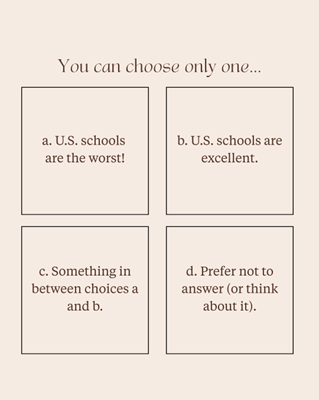
News like this can be difficult to interpret, especially when commentary diverges by geography and topic. It makes one ask: “So, which one is it? U.S. schools are failing? Or U.S. schools are excellent?” When the data gives conflicting results, the answer often lies in the grey area. Perception, context, and expectation guide individual and collective thought on education.
When headlines sound extremely dramatic and negative, it is the perfect time to look at history. The U.S. is a relatively young country. Its education system has seen a lot of change so far: the public-school movement, the establishment of the federal Office of Education, desegregation, and standardized testing. The reality is, political and societal norms influence how America “does” school. Many concepts that were controversial or even accepted in previous decades, like corporal punishment, are now widely rejected. Legally sanctioned spankings or any other type of corporal punishment are foreign to American schoolchildren of 2026. They are faraway tales told by great-grandparents. Yet, just a few generations ago, it was widely accepted to “strap” a child for misbehavior or even innocent misunderstandings.
Education, like every other field, combines the very good with the broken. It promotes human flourishing, builds community, and allows previous generations to prepare the next generation, using the wisdom they have gained in their lifetime. Yes, there are challenges. For instance, COVID-19 was a catalyst for learning loss, political groups have polarizing views on what the issues in education are, and school safety is a real concern (National Institute of Justice, 2019). The good news is that educators, policymakers, and educational researchers are actively working on fixing the parts identified as broken (VDOE, 2025). Through data-driven decision-making, accommodations for exceptional learners, and new safety protocols, educators are implementing meaningful improvements.
In the book of Philippians, Apostle Paul writes, “And I am sure of this, that he who began a good work in you will bring it to completion at the day of Jesus Christ” (1:6, ESV). The “day of Jesus Christ” is not here yet, but there’s hope for the education system. While the system is nuanced and unlikely to please everyone, there are positive stories coming out of the schoolhouse.
EdWeek published an article in 2025 called ‘Gen Z Isn’t Lazy’: Let’s Rethink What We Expect of New Teachers (Booth). The author, school principal Megan Booth, described her initial experience with hiring Gen Z teachers and how she began to reframe her perspective on them. Scheduling downtime, using sick days, saying “no” to optional committee membership, all of those actions could be perceived as “lazy” by some. But with so many studies on teacher burnout, there’s an opportunity to allow educators to take the time they are contractually owed and thus avoid burnout or at least lessen its effects (Walker, 2025). Principals like Dr. Booth address burnout in ways that empower teachers to avoid it (Booth, 2025). There is a danger in getting wrapped up in expansive narratives and losing sight of the day-to-day realities in America’s schools. It does not mean we forget the big picture, but we learn to examine it with decisive care and clarity.
Let’s return to the data in the opening paragraph. Minkin’s article isolated three main concerns for those who stated schools were failing. Those parents believe the core subjects are not receiving enough attention, students in general have fallen behind, and budget cuts are devastating to local schools (Minkin, 2024). These are real and valid concerns.
One way nuance enters the conversation is when we consider the survey respondents. Their local schools, geographic area, news consumption, children’s ages, personal experience with school, and expectations they have for teachers and principals are all things that influenced the responses of the 52% (failing) and 24% (excelling).
This question is not black and white, nor is it static. Contextualizing the situation does not remove the pressing issues, but it allows for a more responsible interpretation and understanding, as parents and educators work together to find answers.
References
Booth, M. (22 May 2025). ‘Gen Z isn’t lazy’: Let’s rethink what we expect of new teachers.
EdWeek. https://www.edweek.org/teaching-learning/opinion-gen-z-isnt-lazy-lets-rethink-what-we-expect-of-new-teachers/2025/05
English Standard Bible. (2016). Crossway Bibles. (Original work published 2001).
Harmon, G. (29 August 2025). Gov. Youngkin says Virginia students’ SOL scores improved
despite harder tests. WTKR. https://www.wtkr.com/news/gov-youngkin-says-virginia-students-sol-scores-improved-despite-harder-tests
Lieberman, M. & Shen, Y. (06 January 2026). School funding: The 3 big questions to watch in
2026. EdWeek. https://www.edweek.org/policy-politics/video-school-funding-the-3-big-questions-to-watch-in-2026/2026/01
Minkin, R. (2024). About half of Americans say public K-12 education is going in the wrong
direction. https://www.pewresearch.org/short-reads/2024/04/04/about-half-of-americans-say-public-k-12-education-is-going-in-the-wrong-direction/
National Institute of Justice. Exhibit 1: School safety by the numbers [Infographic]. https://nij.ojp.gov/media/image/19856
Virginia Department of Education. Data & Reports.
Walker, T. (07 April 2025). What’s causing teacher burnout? National Education Association.