Colbert, Bargatze, and the Question Every Christian Should Be Ready to Answer
Editor's Note: The views and opinions expressed in this article are those of the author and do not necessarily reflect the official policy or position of Regent University, its faculty, administration, or affiliates.
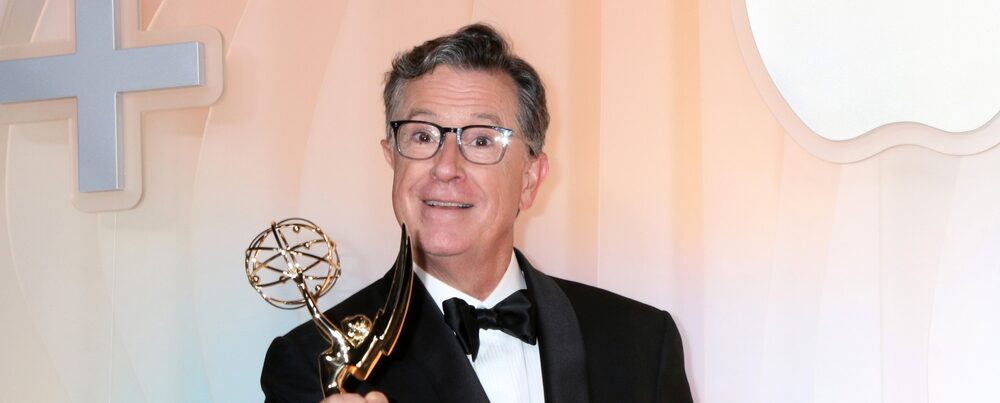
In May, late-night television took a hit as The Late Show with Stephen Colbert ended after an eleven-year run. CBS’s official rationale a year ago was that the show hadn’t generated a high enough viewership to justify its massive production cost. Indeed, the show was losing $40 million a year, and according to cultural commentator Aaron Renn, Colbert’s television audience on his last night was about a tenth of what Johnny Carson’s audience was on his final show in 1992, even though our country now has 80 million more people. But Colbert clearly took the cancellation personally, and many believe that the decision was political, since it came almost immediately after Colbert publicly criticized CBS’s parent company, Paramount, for settling a $16 million lawsuit with President Trump, who had the power to block Paramount’s merger with Skydance.
The Colbert drama may be interesting in itself, and commentators have gone in various directions to dissect this cultural event. According to Renn’s analysis, Colbert’s cancellation speaks not just to the battle between late-night hosts and Donald Trump, but also to the fragmentation of mass media and, in consequence, the loss of a national common culture. But a comparison of recent answers to the question of eternal destiny—answers by Stephen Colbert and Nate Bargatze—highlights the importance of being prepared to provide a reasonable answer to one of life’s biggest questions.
Colbert was known for asking guests on his show a series of questions that resulted in their “being known” by the audience—a questionnaire called “The Colbert Questionert” (meant to rhyme with the way Colbert now pronounces his name). These questions ranged from the mundane (What is the best sandwich?) to the metaphysical (What five words would describe the rest of your life?).
On Colbert’s penultimate show (May 20, 2026), he flipped the script by taking a seat in a guest chair and having friends assume his host chair one by one to ask him the fifteen questions. Fellow Catholic Jim Gaffigan asked the question, “What do you think happens when we die?” and Colbert’s answer was disappointing (skip to 1:39; extended interview here). He first quips, “Remind me, what are we supposed to say as Catholics?” and Gaffigan jokes about going to Purgatory for a few thousand years. Finally, Colbert says, “I think there’s a continuance of some kind, but it’s like a dispersion of the self into some other greater being. And I don’t have any other feelings beyond that.” Gaffigan rightly counters, “What you’re saying is we become Febreze.”
It’s not exactly as if Colbert has been shy about his faith in the past. On The Late Show, he has had blunt conversations with agnostic-atheist Ricky Gervais about the existence of God and friendly interactions with other professing Catholics, such as Gaffigan. Colbert even met Pope Francis in 2024 and had no problem bragging about it on his show, although he did slip in a few barbs at the Catholic Church. In fact, after a 2022 discussion with Dua Lipa about comedy and faith, in which Colbert openly spoke about love, eternity, and giving yourself for others, New York City pastor Tim Keller remarked on Twitter that Colbert’s comments provided “a brilliant example of how to be a Christian in the public square.”
In this case, however, Colbert appeared to be terribly unprepared. There were about ten months between his being notified of the show’s cancellation and his final show, so he had plenty of time to compose answers to his own questionnaire. As a professing Catholic, why didn’t he provide more of a standard Christian answer?
At age 62, Colbert’s career might be slowing down, but Nate Bargatze’s career is really taking off. According to Pollstar’s year-end reporting, Bargatze was the highest-grossing comic in 2025, earning more than $77 million. Bargatze is known for his self-deprecating humor, and he often creatively recycles the same formula in multiple sketches, such as the two George Washington skits on SNL (2023, 2024), the Nashville Christmas special (2024), and the Emmys opening sketch about the development of television (2025). His first movie, Breadwinner, was released at the end of May, and he even has plans to build a theme park in Nashville.
Unfortunately, less than a week after Colbert’s disappointing answer to the afterlife question, Bargatze also whiffed while interviewing on Mythical Kitchen’s show Last Meals (skip to 54:34). The show always begins with the fact that everyone has two things in common—“we all gotta eat, and we’re all gonna die”—and by the end, host Josh Sherer asks every guest, “What do you think happens when you die?”
Bargatze hemmed and hawed an answer that surely made Christians cringe: “Well, as a Christian . . . not that I know everything about everything . . . I’m not the best Christian. . . . I’m a very ‘do you, be everybody, be everything’ . . . but I don’t know. I don’t have the answer—I’m not smart enough. I don’t know what to say… I do believe that there is an afterlife, and that’s where I would hope to be.” Immediately after that answer, during the lightning round of questions, Bargatze is asked whom he would want to share his last meal with, and he answers, “Jesus,” although it sounds a little like it’s out of guilt. He concludes the interview by saying that his last words might be “I hope it’s Jesus,” referring to what an unsure dying person might say about what awaits him in the afterlife.
I wish the contrast between Colbert’s and Bargatze’s answers were starker. Like Colbert’s situation, Bargatze’s questions occurred in a non-hostile environment, and the guests knew what the questions would be beforehand, so there was no reason to be unprepared. What is clear, however, is that Bargatze was on Last Meals to promote his movie, and while not admirable, it is understandable that someone would want to avoid alienating a large audience of tentative ticket-buyers.
About ten minutes earlier in the interview, Bargatze says, “I should be for everybody.” He acknowledges that he’s from the South and a Christian, but he doesn’t want to exclude anyone. This stance fits well with his self-deprecating humor and his avoidance of politics, but it also fits well with the fact that he’s promoting a movie that he wants to be successful. Michael Jordan famously said that he didn’t want to get involved in Democratic politics, partly because he didn’t know the issues very well, and partly because “Republicans buy sneakers, too.”
But being all things for all men isn’t always possible, and the Apostle Paul certainly wasn’t promoting relativism when he says something similar in 1 Corinthians 9:22. Comedian Pete Holmes acknowledges this reality in his 2023 special, I Am Not for Everyone. Holmes points to the atheist absurdity of believing that something comes from nothing. When it comes to the question of what happens when you die, the atheist’s answer is just as absurd as his answer to the question of human origins: you come from nothing, and when you die, you go back into nothing. Holmes’s incredulity is humorous: “That’s Heaven!” (See here—language warning.) The irony is that while Bargatze wants to be for everybody, Holmes’s special is titled I Am Not for Everyone but provides a better answer regarding the afterlife question. Holmes is aware of the philosophical difficulties of denying God’s existence, and it takes real courage, in a comedy world that he describes as basically being full of atheists, to be open about belief in God. The gospel is indeed for the whole world, but there is nevertheless an exclusivity to the invitation: the afterlife does exist, and Jesus is the only way to an afterlife of peace with God.
The poor answers from Colbert and Bargatze point to the value of creeds and catechisms, which provide for us words that we can’t always express spontaneously, since skilled facility with language often takes years of education and practice. At the very least, Colbert and Bargatze could have affirmed what is professed in the Apostles’ Creed, that “I believe in . . . the resurrection of the body, and the life everlasting.” It is not my place to make a final judgment of who is in or out of God’s kingdom, or to harshly evaluate people who are publicly put on the spot. But we can evaluate fruit, and some fruit could use ripening.
I’ve written before that it’s important to teach students what to think as well as how to think. This does not mean spoon-feeding rote responses and expecting only regurgitation on tests, but it does mean initiating students into a tradition that has been handed down from previous generations—a tradition shaped by Western and Christian values. And of those values, not least of which is the expectation that we be prepared to give a reason for the hope that is in us (1 Peter 3:15).